Catch Up AI Selected as a Venture Atlanta 2026 Showcase Company
Catch Up AI has been selected as a Venture Atlanta 2026 Showcase Company, recognizing its AI management layer for performance and retention.
September 10, 2026
A retention risk flag is not a plan. Use this practical five step manager framework to explain, validate, assign, act, and follow up after risk is identified.
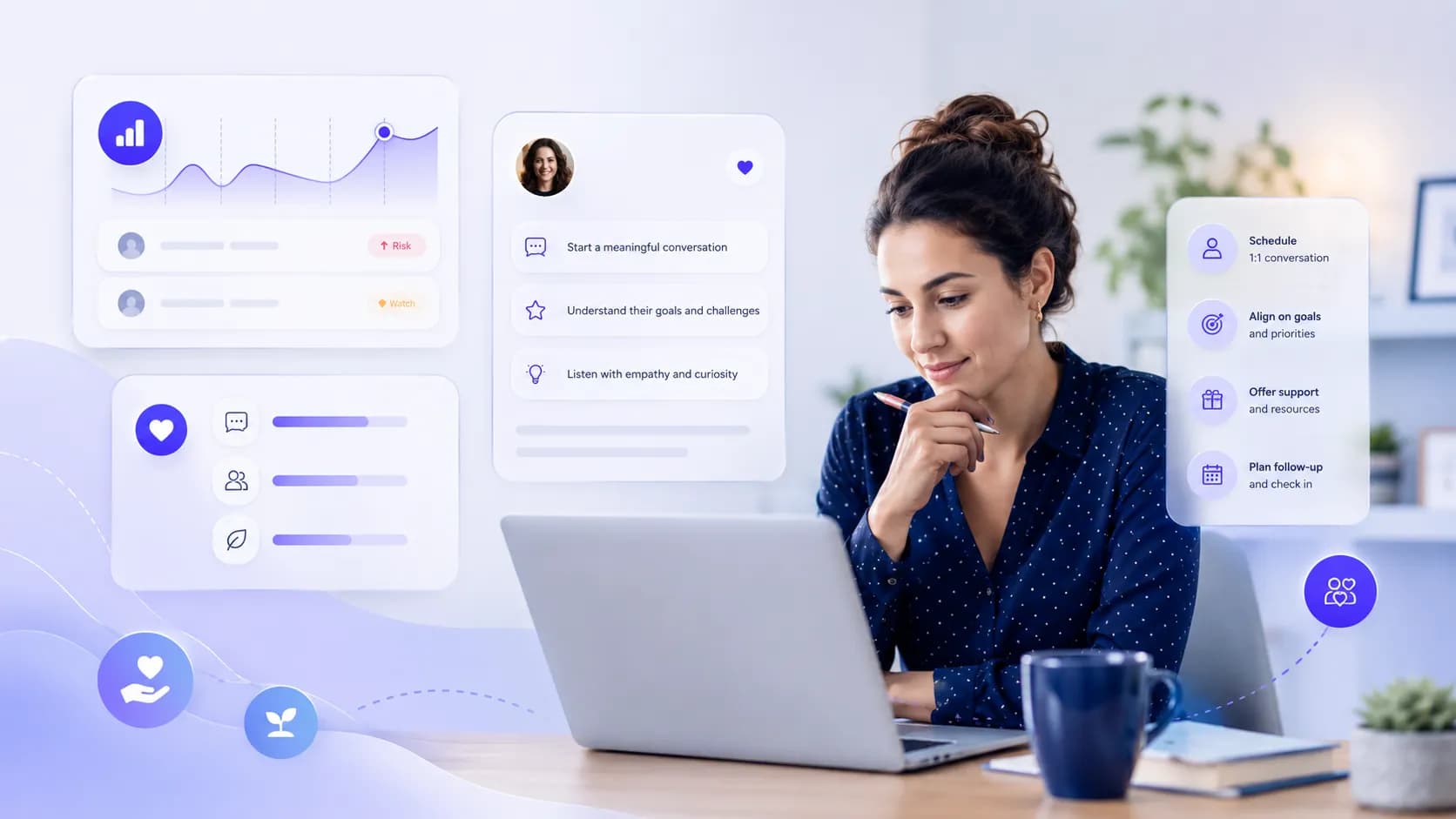
A risk flag is not a plan. Here is the five step framework a manager can actually follow after a retention risk surfaces, including what to say, what to avoid, and how to make sure it does not quietly fall through.
A retention risk has surfaced for someone on your team. The signals are there, the concern is real. Now what?
This is the moment where most retention programs stall. Not because managers do not care, but because a risk flag is not a plan. Told that someone is at risk, a good manager still faces a blank page: what do I actually do, what do I say, and how do I do it without making things worse?
Catch Up AI is built around this exact handoff: turning a signal into a practical manager step while the relationship can still be protected. The framework below maps to five steps: Explain, Validate, Assign, Act, Follow Up. It is deliberately practical, because the whole point is to turn a signal into a human conversation while there is still time.
Before you do anything, understand the case. A useful risk flag comes with its reasons: the specific factors behind it, drawn from real signals, not just a score. Read them.
Maybe collaboration dropped across recent sprints. Maybe someone was passed over in the last promotion cycle. Maybe sentiment shifted after a manager change or a stretch of heavy load. The reasons shape everything that follows, because a conversation about workload is a completely different conversation from one about career growth.
If the flag is just a number with no explanation, that is a problem with the tool, not a reason to wing it. You cannot have a good conversation about a risk you do not understand. Where the reasons come from and how sources combine is covered in the guide to signal sources.
You know things the data does not. You are the reality check.
Look at the flagged reasons against what you actually see. Is the collaboration drop a disengagement signal, or is this person heads down on a solo project? Did sentiment dip because of something real, or something that already resolved? Validation is not about dismissing the flag. It is about separating a genuine, actionable situation from noise, so you spend your energy where it counts and keep your trust in the signal intact.
Sometimes validation ends the process: there is a simple, benign explanation, and that is a good outcome. More often it confirms the situation is worth a conversation, and now you are having it with context rather than reacting to an alert.
For a direct report, the owner is usually you. But ownership still has to be explicit, because unowned actions are exactly how cases slip.
If the right next step involves someone else, a skip level, a People Business Partner, or a peer who knows the situation better, name them and hand it over clearly rather than assuming. The rule is simple: every validated risk has exactly one person responsible for the next step. Ambiguity between roles is the most common reason nothing happens, so remove it up front. That ownership gap is one of the biggest causes of the action gap.
This is the step that matters, and it is where a little structure goes a long way. A few principles hold across almost every case.
Lead with the person, not the data. Never open with we noticed your activity dropped. That feels like surveillance and puts people on the defensive. Open like a manager who pays attention: I wanted to check in, how are things feeling right now?
Acknowledge before you ask. If you know load has been heavy, say so first. People open up when they feel seen, not audited.
Ask, do not diagnose. You have a hypothesis from the signals. Hold it lightly. Ask open questions and let the person tell you what is real. The signals told you where to look, not what the answer is.
Do not lead with performance. A retention conversation and a performance conversation are different conversations. Mixing them makes people guarded and turns a supportive check in into a threat.
Leave with something concrete. A good conversation ends with a real next step: a workload adjustment, a growth discussion, or a follow up scheduled. Not a vague we should talk more.
The exact opening depends on the case. Someone stretched by workload needs a different first sentence from someone stalled on career growth. Good retention tooling can suggest a specific, context aware opening move for the situation, so the manager starts from a strong first line rather than a blank page. The manager still decides. The tool removes the hardest part of starting.
The conversation is not the end. Retention is rarely fixed in a single sitting, and a case that is not tracked is a case that quietly reopens.
Record that the conversation happened and what came out of it. Schedule the concrete next step you agreed. Check back in and note whether things actually improved. This does two things: it makes sure the situation does not fall through after the initial effort, and it builds a record of what worked, so both you and your organization get better at this over time. Follow up is not admin. It is what makes the save stick.
Explain, Validate, Assign, Act, Follow Up.
Understand why it was flagged. Confirm it is real. Make sure someone owns it. Have a human, specific conversation. Close the loop and track the outcome.
This is the manager facing half of retention forecasting. The other half, how risks are detected and prioritized in the first place, is covered in the pillar guide on retention forecasting.
For teams that want the system to support this handoff, Flight Risk Intelligence helps connect the reason behind a risk to a safer next step, so the manager is not left interpreting a score alone.
Managers act consistently when they have a clear framework and specific next steps, and inconsistently when they are handed a score and left to improvise. A Retention Forecast Review looks at how your managers currently move from a flagged risk to a conversation, and where a clearer action framework would help. Twenty minutes, and not a product demo.
If your team wants to see where manager action gets stuck today, review workflow.
Continue reading more insights from CatchUp AI

