Catch Up AI Selected as a Venture Atlanta 2026 Showcase Company
Catch Up AI has been selected as a Venture Atlanta 2026 Showcase Company, recognizing its AI management layer for performance and retention.
September 10, 2026
Your HRIS already holds retention signals. Learn which fields matter most, how to read them together, and how to turn HRIS data into earlier manager action.
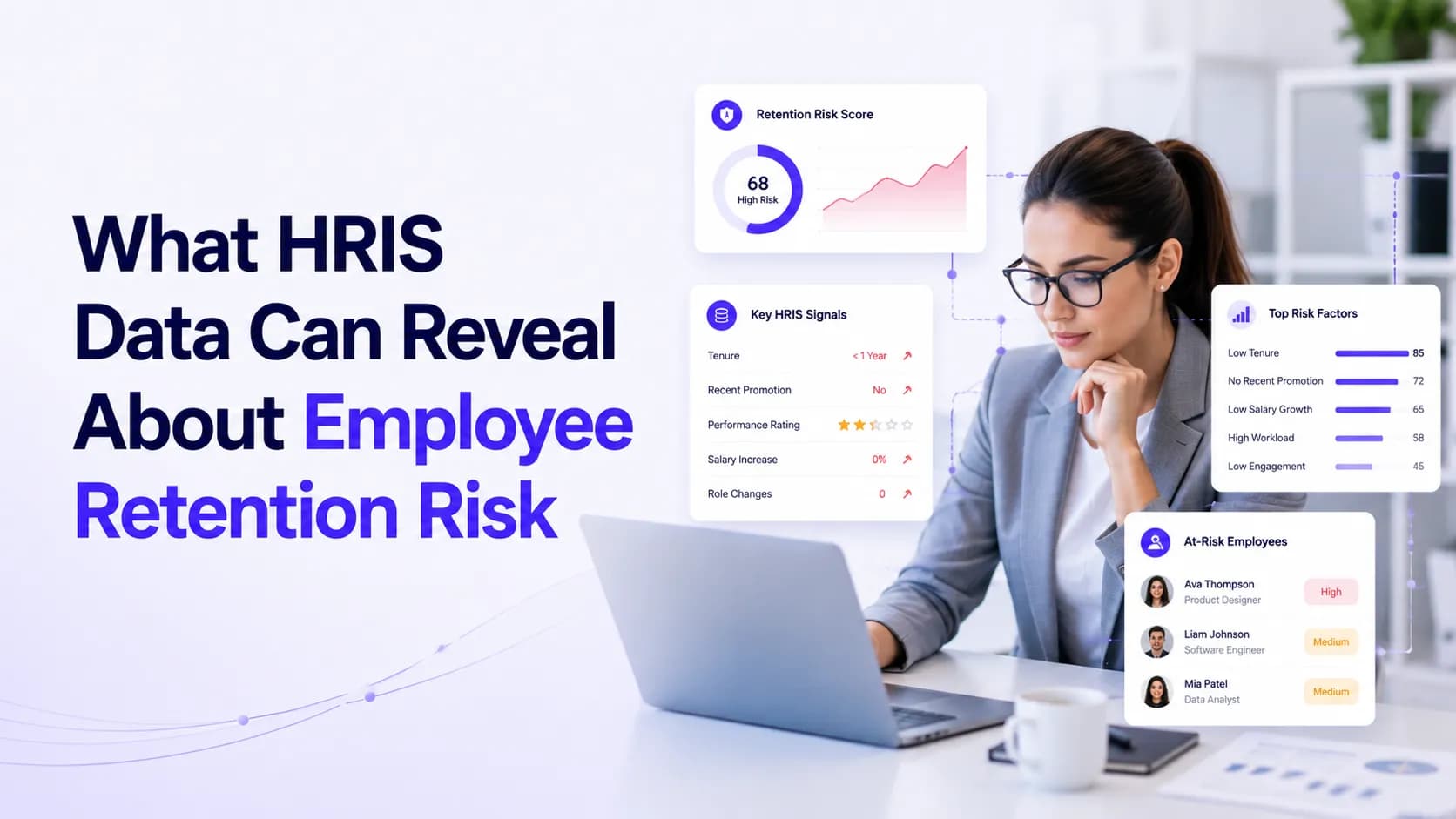
Your HRIS is the most underused retention asset you own. Here are the eight fields that carry the most signal, what each one tells you, and why they only work when you read them together.
Ask most People teams where their richest retention data lives and they will point to engagement surveys. Surveys matter, but they run on a schedule and depend on who chooses to answer. For teams using Catch Up AI, the bigger opportunity is often closer than it looks: the data you have on every employee, all the time, already updated, is in your HRIS.
The catch is that HRIS retention signal is quiet. No single field says at risk. The signal lives in trajectories and combinations, and reading it across your whole workforce every week is not something anyone can do by hand. That is exactly why it goes unused.
Here are the eight fields that carry the most retention signal, what each one tells you, and the combinations that matter most.
Tenure is the oldest retention signal there is, and it still works. Risk tends to cluster at predictable points: the first year, and the stretch where someone has been in the same role long enough to wonder what is next. Time in role is often the sharper of the two. A capable person who has done the same job for a while, with no visible path forward, is in a common and preventable pre departure pattern.
On its own, tenure is context, not conclusion. Its value comes from pairing it with what has, or has not, changed around it.
Few events move retention risk like a change of manager. The manager relationship is one of the strongest drivers of whether people stay, so a reassignment resets that relationship for better or worse. A recent manager change, especially a second or third within a short span, deserves attention, because the new relationship may not have had time to form and the employee may feel unseen during the transition.
This is one of the most actionable HRIS signals precisely because it points to a clear, human intervention.
A role change can be a promotion, a lateral move, a reorganization, or a quiet reshaping of responsibilities. Each carries different risk. A move someone chose usually lowers risk. A move that happened to them, particularly one that narrowed their scope or added load without recognition, can raise it. What matters is not that the role changed, but whether the change matched what the person wanted.
Promotion timing is one of the clearest signals in the system. Being passed over in a cycle, or watching peers advance while staying static, is a frequent trigger for people to start looking. The signal is not only whether someone was promoted, but the gap since their last one relative to their peers and their own expectations. A long, unexplained gap for a strong performer is a situation worth getting ahead of.
Absence is a sensitive field, and it should be read with care and never in isolation. What carries signal is change: a shift away from someone's own normal pattern. A person who was consistently present and becomes less so may simply be dealing with something personal, which calls for support rather than suspicion. The point of noticing is to prompt a caring check in, not to police anyone's time.
Compensation is both a driver and a signal. A long stretch without any adjustment, a raise that fell short of expectations, or a widening gap against market or internal peers all raise the chance that someone is reconsidering. Compensation data is most useful when read alongside promotion history and tenure, because together they tell you whether someone's growth in reward has kept pace with their growth in contribution.
Internal mobility cuts both ways. Someone actively moving between teams and taking on new scope is usually engaged and investing in staying. Someone who applied for an internal move and did not get it, or who has had no mobility at all over a long tenure, may be feeling stuck. The absence of movement, for a person whose profile suggests they want it, is as meaningful as movement itself.
Performance trend matters more than any single rating. A steady performer whose output or ratings are drifting down may be disengaging, and a rising performer with no matching recognition or reward may be about to be recruited away by someone who noticed. Both are retention situations, and they look very different. Reading the direction of travel, rather than the latest score, is what turns performance data into an early signal instead of a lagging one.
Take any one of these fields alone and you get noise. Read them together and you get a trajectory.
Consider two employees at the same tenure. One was promoted last quarter, chose a lateral move into a growth area, and has a stable manager. The other is two managers deep in a year, was passed over in the last cycle, and has had no compensation change in two years. The HRIS says something very different about each, and only the combination makes it visible.
This is the real reason HRIS signal goes unused. It is not missing. It is spread across fields, for every employee, changing every week, in volumes no team can track manually. Bringing those fields into one trajectory per person is precisely the job retention forecasting does, and it is why HRIS is the natural place to start. To see how these HRIS trajectories combine with survey and workplace context for a fuller read, see workplace signals.
None of this replaces your HRIS or asks you to move your data. Catch Up AI reads from the system you already run and surfaces the patterns that are already there. Retention forecasting as a whole is covered in the pillar guide, retention forecasting.
You do not need new data to find out how much your HRIS can tell you. A Retention Forecast Review walks through your existing HRIS setup and the retention signals already sitting in it, and shows you where the useful patterns are. It takes twenty minutes and it is not a product demo.
If your team wants to understand what your existing people systems already reveal, see your signals.
Continue reading more insights from CatchUp AI

