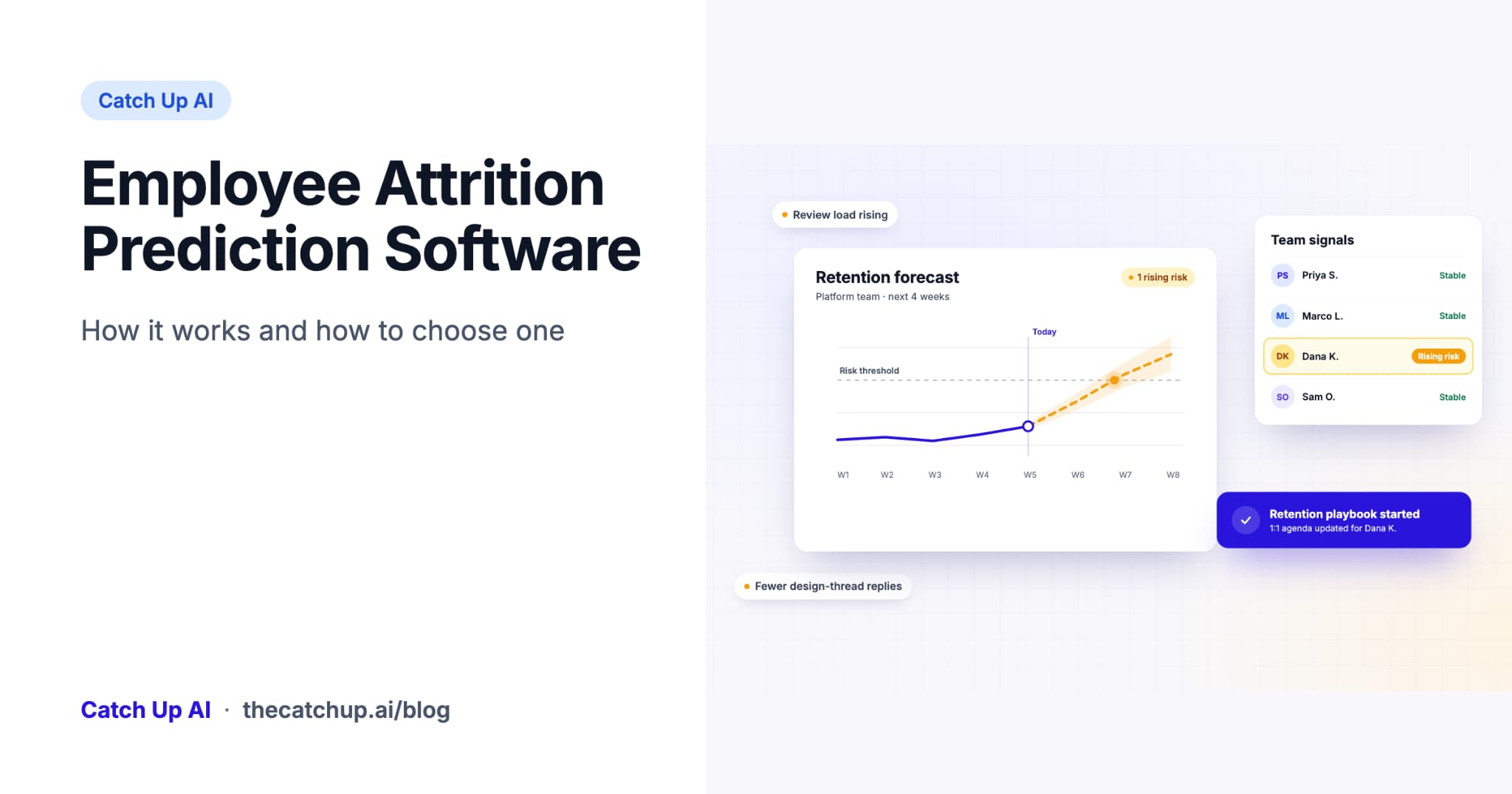
Employee Attrition Prediction Software: How It Works and How to Choose One
Learn how employee attrition prediction software works and compare 8 buying criteria, from data quality and accuracy to privacy and retention workflows.
October 23, 2026
Find the best employee retention tools for 2027. Compare survey, performance, engineering, coaching, and risk tools by use case, with a 6-question checklist.
The best employee retention tools are the ones that match the job you need done. Survey platforms such as Culture Amp are built for listening. Performance suites such as Lattice and 15Five are built for reviews, goals, and 1:1s. Engineering analytics tools such as Jellyfish, LinearB, and DX measure delivery and developer experience. For engineering managers who want to spot retention risk early and act on it, Catch Up AI turns workplace signals into manager follow-up.
Key takeaways
| If you need to... | Tools to look at | Why |
|---|---|---|
| Run engagement and pulse surveys | Culture Amp, Lattice | Built around employee feedback and company-wide listening |
| Manage reviews, goals, and 1:1s | Lattice, 15Five | Performance and manager workflows for the whole company |
| Measure engineering delivery | Jellyfish, LinearB | Engineering metrics from code and ticket data |
| Measure developer experience | DX | Structured developer experience research and benchmarks |
| Offer coaching and support | BetterUp | Coaching for employees and managers |
| Spot retention risk in engineering teams and prepare the manager response | Catch Up AI | Work signals tied to risk explanations and manager actions |
These are summaries of how each company describes itself, not rankings. Many companies use more than one category.
Retention software usually does one of four jobs.
Surveys and pulse checks ask people how they feel. They give employees a voice, but they depend on participation and arrive on a schedule.
Performance and goal tools keep reviews, 1:1s, and development plans in one place. They help managers stay consistent, but they mostly record what people report, not what is changing in daily work.
These tools read ticket and code data to show flow and delivery. They explain how work moves. They are less focused on how people are doing.
Risk tools estimate where a retention concern may be building and suggest a next step. The guide to employee attrition prediction software explains what to ask for, including accuracy, explanations, and privacy.

| Tool type | Main limit to plan for |
|---|---|
| Survey platforms | Cannot see changes between surveys. Workload that grows in March may not show until a June survey. |
| Performance suites | Built for the whole company, so engineering work patterns such as review queues and incident duty may be missed. |
| Engineering analytics | Designed around delivery. Check how they handle retention risk and the manager conversation after it. |
| Coaching services | Help individuals. They work alongside a team-level view and do not replace one. |
Look for software that understands engineering work, such as review queues, tickets, and incident duty, and gives managers an explained next step. Catch Up AI is the autonomous manager for AI-native engineering teams. Its Flight Risk Intelligence offering adds why-flagged explanations, confidence information, and recommended actions.
It does not replace a survey platform or a company-wide performance suite. Many teams run those alongside it, and Catch Up AI lists a Lattice integration. To weigh it against a specific tool, use the comparison hub, including Catch Up AI vs 15Five and Catch Up AI vs Jellyfish. A risk indicator can help prioritize attention. It cannot guarantee that a resignation will be predicted or prevented.
There is no single best tool. Survey platforms suit listening, performance suites suit reviews and goals, engineering analytics suit delivery, and risk tools suit early attention and follow-up. Choose by the job you need done.
Pick a tool that understands engineering work and gives managers a next step. Compare a developer experience tool, an engineering analytics tool, and an early-warning tool such as Catch Up AI against your own use case.
Maybe. A performance platform records goals and reviews. If you also want early signals from daily work and a manager workflow built around them, a dedicated retention tool can fill the gap.
Pricing varies by vendor, company size, and package, and it changes. Ask each vendor for a current quote based on your headcount instead of relying on a published number.
Track what managers do after a flag and what happens next, such as check-ins held, changes made, and regretted departures over time. Dashboard activity alone does not show that.
They can be, when the cost of turnover is high and managers act on what the tool shows. The cost of employee turnover guide explains how to build that business case.
Check your own retention signals before you commit to a tool.
Continue reading more insights from CatchUp AI